Task Logic#
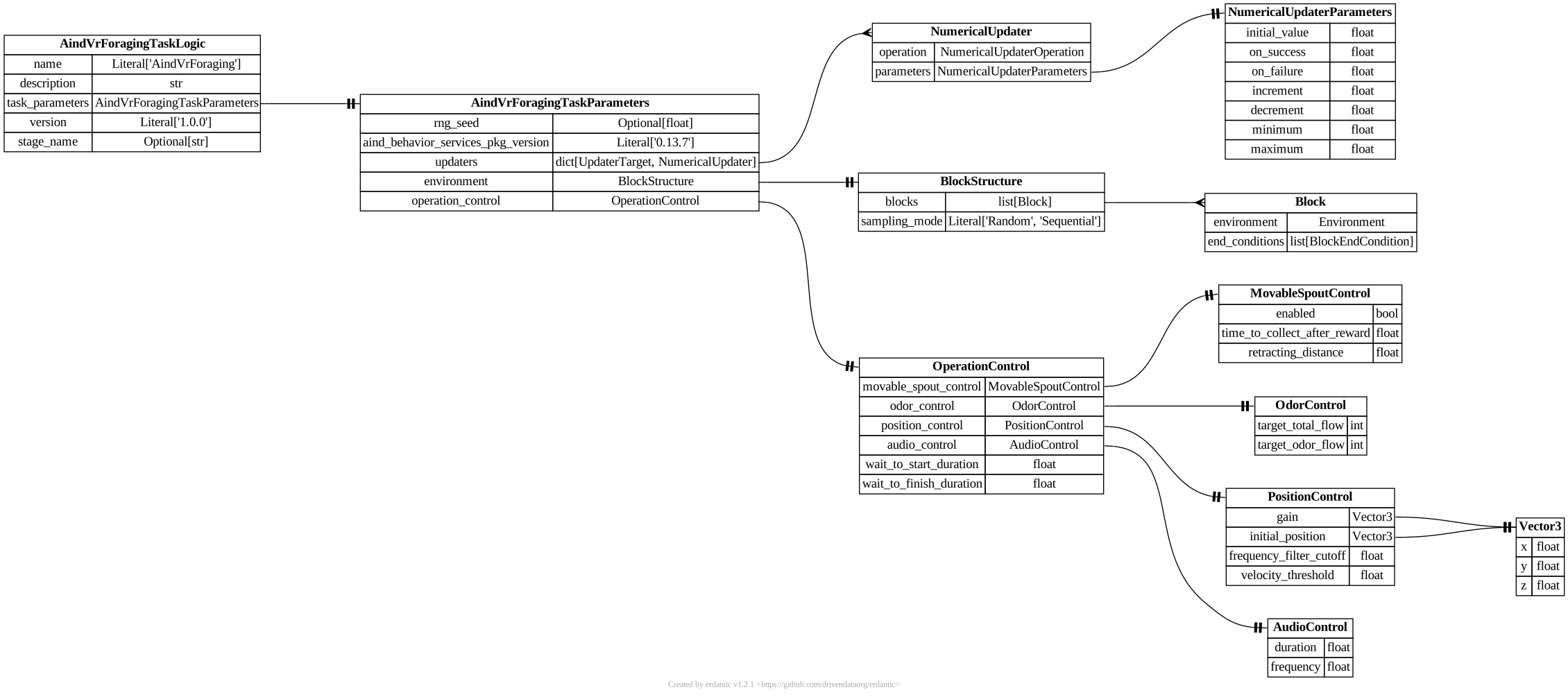
module-attribute
#
PatchUpdateFunction = Union[
    ClampedRateFunction,
    ClampedMultiplicativeRateFunction,
    SaturatingMultiplicativeRateFunction,
    SetValueFunction,
    LookupTableFunction,
    CtcmFunction,
]
module-attribute
#
RewardFunction = Union[
    PatchRewardFunction,
    OutsideRewardFunction,
    OnThisPatchEntryRewardFunction,
    PersistentRewardFunction,
]
module-attribute
#
PatchTerminator = Union[
    PatchTerminatorOnRejection,
    PatchTerminatorOnChoice,
    PatchTerminatorOnReward,
    PatchTerminatorOnTime,
    PatchTerminatorOnDistance,
    PatchTerminatorOnRewardSite,
]
module-attribute
#
Environment = TypeAliasType(
    "Environment",
    Union[MarkovEnvironment, SequenceEnvironment],
)
module-attribute
#
BlockEndCondition = Union[
    BlockEndConditionDuration,
    BlockEndConditionDistance,
    BlockEndConditionChoice,
    BlockEndConditionReward,
    BlockEndConditionPatchCount,
]
pydantic-model
#
pydantic-model
#
Bases: Task
Base class for task schemas.
class-attribute
instance-attribute
#
task_parameters = Field(
    description="Parameters of the task",
    validate_default=True,
)
class-attribute
instance-attribute
#
version = Field(
    pattern=curriculum_task.SEMVER_REGEX,
    description="task schema version",
)
classmethod
#
coerce_version(v)
Source code in .venv/lib/python3.13/site-packages/aind_behavior_services/task/__init__.py
30 31 32 33 | |
Bases: TaskParameters
Base class for storing parameters for the task.
class-attribute
instance-attribute
#
rng_seed = Field(
    default=None,
    description="Seed of the random number generator",
)
class-attribute
instance-attribute
#
aind_behavior_services_pkg_version = Field(
    default=__semver__,
    pattern=SEMVER_REGEX,
    title="aind_behavior_services package version",
    frozen=True,
)
classmethod
#
coerce_version(v, ctx)
Source code in .venv/lib/python3.13/site-packages/aind_behavior_services/task/__init__.py
18 19 20 21 | |
Bases: str, Enum
Enumeration of operations that can be performed by numerical updaters.
These operations define how parameter values are modified during task execution, allowing for dynamic adjustment of task parameters based on performance or other criteria.
class-attribute
instance-attribute
#
OFFSET = 'Offset'
Adds (or subtracts) the update value to the current value. The update value can be positive or negative.
class-attribute
instance-attribute
#
GAIN = 'Gain'
Multiplies the current value by the update value. The update value can be greater or less than 1.
pydantic-model
#
Bases: BaseModel
Parameters that control how numerical updates are applied to task values.
These parameters define the bounds and increments for updating numerical values during task execution, ensuring values stay within acceptable ranges.
Fields:
-
initial_value(float) -
on_success(float) -
on_failure(float) -
increment(float) -
decrement(float) -
minimum(float) -
maximum(float)
Validators:
-
_ensure_backwards_compatibility -
_ensure_backwards_compatibility_after
pydantic-model
#
Bases: BaseModel
A numerical updater that modifies task parameters during execution.
This class combines an operation type with parameters to define how values should be updated dynamically during the task, enabling adaptive behavior based on animal performance or other criteria.
Fields:
pydantic-field
#
operation = NumericalUpdaterOperation.NONE
Operation to perform on the parameter
Bases: str, Enum
Enumeration of parameters that can be targeted by numerical updaters.
These targets define which task parameters can be dynamically modified during task execution to adapt to animal performance or experimental needs.
pydantic-model
#
Bases: BaseModel
Defines visual texture properties for VR environment surfaces.
Textures are applied to walls, floors, and other surfaces in the virtual environment to provide visual cues and context for the foraging task.
Texture name must correspond to a valid texture asset loaded in the workflow.
Fields:
pydantic-model
#
Bases: BaseModel
Defines textures for all walls of a visual corridor in the VR environment.
This class specifies the visual appearance of corridor surfaces including floor, ceiling, and side walls, allowing for complex visual environments with different textures on each surface.
Fields:
pydantic-model
#
Bases: BaseModel
Defines a visual corridor segment in the VR environment.
Visual corridors are the basic building blocks of the VR environment, defining spatial regions with specific textures, dimensions, and positions.
Fields:
-
id(int) -
size(Size) -
start_position(float) -
length(float) -
textures(WallTextures)
pydantic-model
#
Bases: BaseModel
Defines operant conditioning logic for reward delivery in the VR foraging task.
This class controls when and how rewards are delivered based on animal behavior, implementing stopping requirements, collection timeouts, and spatial constraints.
Fields:
-
is_operant(bool) -
stop_duration(Distribution) -
time_to_collect_reward(float) -
grace_distance_threshold(Optional[float]) -
abort_on_not_stop(bool)
pydantic-field
#
stop_duration = scalar_value(0)
Duration (s) the animal must stop for to lock its choice
pydantic-field
#
time_to_collect_reward = 100000
Time(s) the animal has to collect the reward
pydantic-field
#
grace_distance_threshold = 10
Virtual distance (cm) the animal must be within to not abort the current choice
pydantic-field
#
abort_on_not_stop = False
Whether to abort the waiting period if the animal leaves a stopped state.
pydantic-model
#
Bases: BaseModel
Base class for patch update functions.
This is an internal base class that defines the common interface for all patch update function types. Should not be instantiated directly.
Fields:
-
function_type(str)
pydantic-model
#
Bases: _PatchUpdateFunction
A patch update function that uses lookup table interpolation.
Update in the form of x = lut_values[lerp(lut_keys, lut_values, tick_value)]. This function maps input values to output values using a lookup table with linear interpolation between defined points. Useful for complex, non-linear reward schedules or parameter updates.
Fields:
-
function_type(Literal['LookupTableFunction']) -
lut_keys(List[float]) -
lut_values(List[float])
Validators:
-
_validate_lut
pydantic-model
#
Bases: _PatchUpdateFunction
A patch update function that applies a clamped rate-based update.
Update in the form of x = clamp(x + rate * tick_value). This function updates values at a specified rate while keeping results within defined minimum and maximum bounds. The rate is applied per rule unit (e.g., time, distance, choices).
Fields:
-
function_type(Literal['ClampedRateFunction']) -
minimum(Optional[float]) -
maximum(Optional[float]) -
rate(Distribution)
pydantic-model
#
Bases: _PatchUpdateFunction
A patch update function that applies multiplicative rate updates with bounds.
Update in the form of x = clamp(x * rate ** tick_value). This function multiplies the current value by the rate parameter, maintaining the result within specified minimum and maximum bounds. Useful for percentage- based changes and exponential decay/growth patterns.
Fields:
-
function_type(Literal['ClampedMultiplicativeRateFunction']) -
minimum(Optional[float]) -
maximum(Optional[float]) -
rate(Distribution)
pydantic-model
#
Bases: _PatchUpdateFunction
Multiplicative updater with configurable out-of-bounds rectification.
The raw update is computed as x_raw = x * rate ** tick_value.
If x_raw is within bounds, it is returned unchanged.
If it falls below minimum or above maximum, the output is rectified to
below_minimum_to or above_maximum_to respectively when provided;
otherwise it falls back to the corresponding bound.
Fields:
-
function_type(Literal['SaturatingMultiplicativeRateFunction']) -
minimum(Optional[float]) -
maximum(Optional[float]) -
below_minimum_to(Optional[float]) -
above_maximum_to(Optional[float]) -
rate(Distribution)
pydantic-model
#
Bases: _PatchUpdateFunction
A patch update function that sets the target to a specific value.
Update in the form of x = value. This function directly sets the target parameter to a value drawn from the specified distribution, ignoring the current value. Useful for resetting parameters or applying discrete changes.
Fields:
-
function_type(Literal['SetValueFunction']) -
value(Distribution)
pydantic-model
#
Bases: _PatchUpdateFunction
A patch update function that uses a continuous-time Markov chain (CTMC) to determine patch updates based on a transition probability matrix.
It expects a transition matrix that takes the current value of the variable of interest (e.g. Probability), and outputs a new value based on the defined stochastic process in the transition matrix.
Fields:
-
function_type(Literal['CtcmFunction']) -
transition_matrix(List[List[NonNegativeFloat]]) -
rho(float) -
dt(Literal[0.1]) -
rate(Optional[float]) -
minimum(float) -
maximum(float)
Validators:
pydantic-field
#
rate = None
Rate of the replenishment used to generate the matrix. This value is used for metadata keep sake only
pydantic-validator
#
validate_transition_matrix(value)
Ensures matrix is of valid format and normalized to 1 within rows
Source code in src/packages/aind_behavior_vr_foraging/src/aind_behavior_vr_foraging/task_logic.py
330 331 332 333 334 335 336 337 338 339 340 341 342 | |
serialize_transition_matrix(value)
Round to 15 significant digits for deterministic serialization across platforms.
Source code in src/packages/aind_behavior_vr_foraging/src/aind_behavior_vr_foraging/task_logic.py
344 345 346 347 | |
classmethod
#
from_replenishment_rate(
    n_states, replenishment_rate, rho, dt=0.1
)
Computes the replenishment transition probability matrix for each patch Parameters
n_states: int number reward states per patch. replenishment_rate: float replenishment rate. rho: float The underlying value governing the stochastic process dt: float experiment time step
Returns#
CtcmFunction Instance of CtcmFunction with computed transition matrix.
Source code in src/packages/aind_behavior_vr_foraging/src/aind_behavior_vr_foraging/task_logic.py
349 350 351 352 353 354 355 356 357 358 359 360 361 362 363 364 365 366 367 368 369 370 371 372 373 374 375 376 377 378 379 380 381 382 383 384 385 386 387 388 389 390 | |
Bases: str, Enum
Enumeration of rules that trigger reward function updates.
These rules define when and how reward replenishment occurs, with different triggers based on animal behavior, time passage, or spatial navigation.
class-attribute
instance-attribute
#
ON_REWARD = 'OnReward'
Triggers after a reward is delivered. The tick value is always 1.
class-attribute
instance-attribute
#
ON_REWARD_AMOUNT = 'OnRewardAmount'
Triggers after a reward is delivered. The tick value is the amount of reward.
class-attribute
instance-attribute
#
ON_CHOICE = 'OnChoice'
Triggers after a choice is made. The tick value is always 1.
class-attribute
instance-attribute
#
ON_TIME = 'OnTime'
Triggers periodically. The tick value is the elapsed time since the last update (s).
class-attribute
instance-attribute
#
ON_DISTANCE = 'OnDistance'
Triggers periodically. The tick value is the distance traveled since the last update (cm).
class-attribute
instance-attribute
#
ON_THIS_PATCH_ENTRY = 'OnThisPatchEntry'
Triggers when the animal enters the patch. The tick value is always 1.
class-attribute
instance-attribute
#
ON_PATCH_ENTRY = 'OnPatchEntry'
Triggers when the animal enters any patch. The tick value is always 1.
class-attribute
instance-attribute
#
ON_CHOICE_ACCUMULATED = 'OnChoiceAccumulated'
Triggers after a choice is made. The tick value is the accumulated number of choices.
class-attribute
instance-attribute
#
ON_REWARD_ACCUMULATED = 'OnRewardAccumulated'
Triggers after a reward is delivered. The tick value is the accumulated number of rewarded events.
class-attribute
instance-attribute
#
ON_TIME_ACCUMULATED = 'OnTimeAccumulated'
Triggers periodically. The tick value is the accumulated elapsed time since patch creation (s).
class-attribute
instance-attribute
#
ON_DISTANCE_ACCUMULATED = 'OnDistanceAccumulated'
Triggers periodically. The tick value is the accumulated distance traveled since patch creation (cm).
pydantic-model
#
Bases: BaseModel
Base class for reward functions.
This is an internal base class that defines the common interface for all reward function types. Should not be instantiated directly.
Fields:
-
function_type(str) -
amount(Optional[PatchUpdateFunction]) -
probability(Optional[PatchUpdateFunction]) -
available(Optional[PatchUpdateFunction])
pydantic-model
#
Bases: _RewardFunction
A RewardFunction that is applied when the animal is inside the patch. For the purposes of this function post-patch and inter-patch are excluded.
Fields:
-
amount(Optional[PatchUpdateFunction]) -
probability(Optional[PatchUpdateFunction]) -
available(Optional[PatchUpdateFunction]) -
function_type(Literal['PatchRewardFunction']) -
rule(Literal[ON_REWARD, ON_REWARD_AMOUNT, ON_CHOICE, ON_TIME, ON_DISTANCE, ON_CHOICE_ACCUMULATED, ON_REWARD_ACCUMULATED, ON_TIME_ACCUMULATED, ON_DISTANCE_ACCUMULATED])
pydantic-model
#
Bases: _RewardFunction
A RewardFunction that is applied when the animal is outside of the patch.
Fields:
-
amount(Optional[PatchUpdateFunction]) -
probability(Optional[PatchUpdateFunction]) -
available(Optional[PatchUpdateFunction]) -
function_type(Literal['OutsideRewardFunction']) -
rule(Literal[ON_TIME, ON_DISTANCE, ON_TIME_ACCUMULATED, ON_DISTANCE_ACCUMULATED]) -
delay(float)
pydantic-field
#
delay = 0
Delay (s) before the replenishment starts after the rule is triggered.
pydantic-field
#
probability = None
Defines the probability of reward replenished per rule unit.
pydantic-field
#
available = None
Defines the amount of reward available replenished in the patch per rule unit.
pydantic-model
#
Bases: _RewardFunction
A RewardFunction that is applied when the animal enters the patch.
Fields:
-
amount(Optional[PatchUpdateFunction]) -
probability(Optional[PatchUpdateFunction]) -
available(Optional[PatchUpdateFunction]) -
function_type(Literal['OnThisPatchEntryRewardFunction']) -
rule(Literal[ON_THIS_PATCH_ENTRY])
pydantic-model
#
Bases: _RewardFunction
A RewardFunction that is always active.
Fields:
-
amount(Optional[PatchUpdateFunction]) -
probability(Optional[PatchUpdateFunction]) -
available(Optional[PatchUpdateFunction]) -
function_type(Literal['PersistentRewardFunction']) -
rule(Literal[ON_REWARD, ON_CHOICE, ON_TIME, ON_DISTANCE, ON_CHOICE_ACCUMULATED, ON_REWARD_ACCUMULATED, ON_TIME_ACCUMULATED, ON_DISTANCE_ACCUMULATED, ON_PATCH_ENTRY])
pydantic-model
#
Bases: BaseModel
Specifies reward parameters and behavior for a patch.
This class defines all aspects of reward delivery including amounts, probabilities, delays, operant logic, and dynamic update functions. It serves as the complete specification for how rewards are managed in a given Patch.
Fields:
-
operant_logic(Optional[OperantLogic]) -
delay(Distribution) -
amount(Distribution) -
probability(Distribution) -
available(Distribution) -
reward_function(List[RewardFunction])
pydantic-field
#
delay = scalar_value(0)
The optional distribution where the delay to reward will be drawn from
pydantic-field
#
available = scalar_value(10)
Initial amount of reward available in the patch in microliters
Bases: str, Enum
Enumeration of virtual site types in the VR foraging environment.
These labels categorize different regions of the virtual environment, each serving different functional roles in the foraging task.
class-attribute
instance-attribute
#
INTERPATCH = 'InterPatch'
Region rendered before entering a patch
class-attribute
instance-attribute
#
POSTPATCH = 'PostPatch'
Region rendered after leaving a patch
class-attribute
instance-attribute
#
REWARDSITE = 'RewardSite'
Region where rewards are delivered
class-attribute
instance-attribute
#
INTERSITE = 'InterSite'
Region between sites within a patch
pydantic-model
#
Bases: BaseModel
Defines visual rendering properties for virtual environment elements.
This class controls the visual appearance of virtual sites, including contrast and other visual parameters that affect how elements are rendered in the VR environment.
Fields:
-
contrast(Optional[float])
pydantic-model
#
Bases: BaseModel
Defines treadmill friction properties for virtual sites.
This class controls the friction experienced by the animal when moving through different virtual sites, allowing for varied locomotion dynamics across different regions of the environment.
Fields:
-
friction(Optional[Distribution])
pydantic-field
#
friction = None
Friction of the treadmill (0-1). The drawn value must be between 0 and 1
pydantic-model
#
Bases: BaseModel
Generates virtual site specifications with randomized properties.
This class defines templates for creating virtual sites with variable properties like length and rendering specifications. It's used to generate diverse virtual environments for the foraging task.
Fields:
-
render_specification(RenderSpecification) -
label(VirtualSiteLabels) -
length_distribution(Distribution) -
treadmill_specification(Optional[TreadmillSpecification])
pydantic-field
#
render_specification = RenderSpecification()
Contrast of the environment
pydantic-field
#
length_distribution = scalar_value(20)
Distribution of the length of the virtual site
pydantic-model
#
Bases: BaseModel
Defines the generation specifications for all virtual site types within a patch.
This class contains generators for all the different types of virtual sites that can appear within a patch environment. Each generator defines how sites of that type should be created with their properties and distributions.
Fields:
-
inter_site(VirtualSiteGenerator) -
inter_patch(VirtualSiteGenerator) -
post_patch(Optional[VirtualSiteGenerator]) -
reward_site(VirtualSiteGenerator)
pydantic-field
#
inter_site = VirtualSiteGenerator(
    label=VirtualSiteLabels.INTERSITE
)
Generator of the inter-site virtual sites
pydantic-field
#
inter_patch = VirtualSiteGenerator(
    label=VirtualSiteLabels.INTERPATCH
)
Generator of the inter-patch virtual sites
pydantic-field
#
reward_site = VirtualSiteGenerator(
    label=VirtualSiteLabels.REWARDSITE
)
Generator of the reward-site virtual sites
pydantic-model
#
Bases: BaseModel
THIS CLASS IS NOT MEANT TO BE DIRECTLY INSTANTIATED. Specifies reward parameters and behavior for a virtual site.
Note: This class is primarily used internally for runtime site generation and is not meant to be directly instantiated in task configuration DSL.
Fields:
-
operant_logic(OperantLogic) -
delay(Distribution)
pydantic-field
#
delay = scalar_value(0)
The optional distribution where the delay to reward will be drawn from
pydantic-model
#
Bases: BaseModel
Specifies odor delivery parameters for olfactory cues in the VR environment.
Odors can be delivered at specific locations to provide additional sensory information for navigation and foraging decisions.
Fields:
-
index(int) -
concentration(float)
pydantic-model
#
Bases: BaseModel
THIS CLASS IS NOT MEANT TO BE DIRECTLY INSTANTIATED. Represents a specific virtual site instance in the VR environment.
This class defines a concrete virtual site with specific properties like position, length, and associated specifications. It is typically generated from VirtualSiteGenerator templates rather than being directly instantiated in the DSL.
Note: This class is primarily used internally for runtime site generation and is not meant to be directly instantiated in task configuration DSL.
Fields:
-
id(int) -
label(VirtualSiteLabels) -
length(float) -
start_position(float) -
odor_specification(Optional[OdorMixture]) -
reward_specification(Optional[VirtualSiteRewardSpecification]) -
render_specification(RenderSpecification) -
treadmill_specification(Optional[TreadmillSpecification])
pydantic-field
#
odor_specification = None
The optional odor specification of the virtual site
pydantic-field
#
reward_specification = None
The optional reward specification of the virtual site
pydantic-field
#
render_specification = RenderSpecification()
The optional render specification of the virtual site
pydantic-model
#
pydantic-model
#
Bases: _PatchTerminator
Terminates the patch after a reward site where the animal does not stop in "count" reward sites.
Fields:
-
terminator_type(Literal['OnRejection']) -
count(Distribution)
pydantic-field
#
count = scalar_value(1)
Number of reward sites the animal must not stop in to terminate the patch
pydantic-model
#
Bases: _PatchTerminator
Terminates the patch after "count" choices.
Fields:
-
terminator_type(Literal['OnChoice']) -
count(Distribution)
pydantic-field
#
count = scalar_value(1)
Number of choices the animal must make to terminate the patch
pydantic-model
#
Bases: _PatchTerminator
Terminates the patch after "count" rewards.
Fields:
-
terminator_type(Literal['OnReward']) -
count(Distribution)
pydantic-field
#
count = scalar_value(1)
Number of rewards the animal must collect to terminate the patch
pydantic-model
#
Bases: _PatchTerminator
Terminates the patch after a "count" seconds.
Fields:
-
terminator_type(Literal['OnTime']) -
count(Distribution)
pydantic-model
#
Bases: _PatchTerminator
Terminates the patch after a "count" distance.
Fields:
-
terminator_type(Literal['OnDistance']) -
count(Distribution)
pydantic-model
#
Bases: _PatchTerminator
Terminates the patch after visiting a specific site count.
Fields:
-
terminator_type(Literal['OnRewardSite']) -
count(Distribution)
pydantic-model
#
Bases: BaseModel
Represents statistics for a patch in the VR foraging task.
Fields:
-
label(str) -
state_index(int) -
odor_specification(OdorMixture) -
reward_specification(RewardSpecification) -
patch_virtual_sites_generator(PatchVirtualSitesGenerator) -
patch_terminators(List[PatchTerminator])
Validators:
-
_ensure_backwards_compatibility
pydantic-field
#
odor_specification = [1.0, 0.0, 0.0]
A list of odor concentrations for the patch, where the index of the list corresponds to the odor channel
pydantic-field
#
reward_specification = RewardSpecification()
The optional reward specification of the patch
pydantic-field
#
patch_virtual_sites_generator = PatchVirtualSitesGenerator()
Virtual site generation specification
pydantic-field
#
patch_terminators = [PatchTerminatorOnRejection()]
The optional termination specification of the patch
pydantic-model
#
Bases: BaseModel
Defines the statistical properties of the foraging environment.
This class specifies the patches available in the environment, their transition probabilities, and initial state occupancy. It forms the core specification for the foraging environment structure.
Fields:
-
environment_type(str) -
patches(List[Patch])
pydantic-model
#
Bases: _Environment
Defines the statistical properties of the foraging environment.
This class specifies the patches available in the environment, their transition probabilities, and initial state occupancy. It forms the core specification for the foraging environment structure.
Fields:
-
patches(List[Patch]) -
environment_type(Literal['Markov']) -
transition_matrix(List[List[NonNegativeFloat]]) -
first_state_occupancy(Optional[List[NonNegativeFloat]])
Validators:
-
_validate_transition_matrix→transition_matrix
pydantic-model
#
Bases: _Environment
Defines a sequence-based foraging environment.
This class specifies a fixed sequence of patches that the animal will experience, without any probabilistic transitions. It is used for deterministic environment configurations where the order of patches is predefined.
Fields:
-
patches(List[Patch]) -
environment_type(Literal['Sequence']) -
patch_indices(List[int]) -
sampling_mode(Literal['RandomWithoutReplacement', 'Ordered', 'RandomWithReplacement'])
Validators:
-
_validate_patch_indices
pydantic-model
#
Bases: BaseModel
Controls the position tracking and movement detection parameters.
This class manages the position control system including coordinate transformations, initial positioning, signal filtering, and movement detection thresholds for the virtual reality foraging task.
Fields:
-
gain(Vector3) -
initial_position(Vector3) -
frequency_filter_cutoff(float) -
velocity_threshold(float)
pydantic-field
#
initial_position = Vector3(x=0, y=2.56, z=0)
Initial position of the subject in the VR world.
pydantic-field
#
frequency_filter_cutoff = 0.5
Cutoff frequency (Hz) of the low-pass filter used to filter the velocity signal.
pydantic-field
#
velocity_threshold = 1
Threshold (cm/s) of the velocity signal used to detect when the animal is moving.
pydantic-model
#
Bases: BaseModel
Controls audio feedback parameters for the task.
This class manages audio cue generation including tone duration and frequency for auditory feedback during the behavioral task.
Fields:
pydantic-model
#
Bases: BaseModel
Controls the odor delivery system parameters.
This class manages the olfactory stimulus delivery system, including flow rates, valve timing, and carrier gas configuration. It ensures proper odor concentration and delivery timing for the behavioral task.
Fields:
-
target_total_flow(int) -
target_odor_flow(int)
pydantic-model
#
Bases: BaseModel
Master control class for all operational hardware systems.
This class aggregates all the hardware control specifications including odor delivery, position tracking, and audio systems. It provides a centralized configuration point for all task hardware.
Fields:
-
odor_control(OdorControl) -
position_control(PositionControl) -
audio_control(AudioControl) -
wait_to_start_duration(float) -
wait_to_finish_duration(float)
pydantic-field
#
odor_control = OdorControl(
    target_odor_flow=100, target_total_flow=1000
)
Control of the odor
pydantic-field
#
wait_to_start_duration = 0
Duration to wait before starting the task
pydantic-field
#
wait_to_finish_duration = 0
Duration to wait after finishing the task
pydantic-model
#
Bases: BaseModel
Base class for block end conditions.
This is an internal base class that defines the common interface for all block end condition types. Should not be instantiated directly.
Fields:
-
condition_type(str)
pydantic-model
#
Bases: _BlockEndConditionBase
Block end condition based on time duration.
This condition ends a block after a specified amount of time has elapsed.
Fields:
-
condition_type(Literal['Duration']) -
value(Distribution)
pydantic-model
#
Bases: _BlockEndConditionBase
Block end condition based on distance traveled.
This condition ends a block after the animal has traveled a specified distance.
Fields:
-
condition_type(Literal['Distance']) -
value(Distribution)
pydantic-model
#
Bases: _BlockEndConditionBase
Block end condition based on number of choices made.
This condition ends a block after the animal has made a specified number of choices (e.g., patch visits or reward attempts).
Fields:
-
condition_type(Literal['Choice']) -
value(Distribution)
pydantic-model
#
Bases: _BlockEndConditionBase
Block end condition based on number of rewards obtained.
This condition ends a block after the animal has obtained a specified number of rewards.
Fields:
-
condition_type(Literal['Reward']) -
value(Distribution)
pydantic-model
#
Bases: _BlockEndConditionBase
Block end condition based on number of patches visited.
This condition ends a block after the animal has visited a specified number of unique patches.
Fields:
-
condition_type(Literal['PatchCount']) -
value(Distribution)
pydantic-model
#
Bases: BaseModel
Configuration for a single experimental block.
A block represents a period of the experiment with specific environment statistics and ending conditions. Each block defines the environmental parameters and termination criteria for that experimental phase.
Fields:
Validators:
-
_migrate_legacy_environment
pydantic-field
#
end_conditions = []
List of end conditions that must be true for the block to end.
pydantic-model
#
Bases: BaseModel
Structure defining the sequence and sampling of experimental blocks.
This class manages multiple experimental blocks and determines how they are presented during the experiment (sequentially or randomly).
Fields:
-
blocks(List[Block]) -
sampling_mode(Literal['Random', 'Sequential'])
Bases: TaskParameters
Complete parameter specification for the AIND VR Foraging task.
This class contains all configurable parameters for the VR foraging task, including environment structure, task mode settings, operation control, and numerical updaters for dynamic parameter modification.
class-attribute
instance-attribute
#
updaters = Field(
    default_factory=dict,
    description="Look-up table for numeric updaters",
)
class-attribute
instance-attribute
#
environment = Field(
    default=BlockStructure(),
    description="Statistics of the environment",
    validate_default=True,
)
class-attribute
instance-attribute
#
operation_control = Field(
    default=OperationControl(),
    description="Control of the operation",
    validate_default=True,
)
class-attribute
instance-attribute
#
rng_seed = Field(
    default=None,
    description="Seed of the random number generator",
)
class-attribute
instance-attribute
#
aind_behavior_services_pkg_version = Field(
    default=__semver__,
    pattern=SEMVER_REGEX,
    title="aind_behavior_services package version",
    frozen=True,
)
classmethod
#
coerce_version(v, ctx)
Source code in .venv/lib/python3.13/site-packages/aind_behavior_services/task/__init__.py
18 19 20 21 | |
Bases: Task
Main task logic model for the AIND VR Foraging task.
This is the top-level class that encapsulates the complete task logic specification for the virtual reality foraging behavioral experiment. It includes all task parameters, environment specifications, and control settings.
class-attribute
instance-attribute
#
name = Field(
    default="AindVrForaging",
    description="Name of the task logic",
    frozen=True,
)
class-attribute
instance-attribute
#
task_parameters = Field(
    default=AindVrForagingTaskParameters(),
    description="Parameters of the task logic",
    validate_default=True,
)
classmethod
#
coerce_version(v)
Source code in .venv/lib/python3.13/site-packages/aind_behavior_services/task/__init__.py
30 31 32 33 | |
scalar_value(value)
Helper function to create a scalar value distribution for a given value.
| PARAMETER | DESCRIPTION |
|---|---|
value
|
The value of the scalar distribution.
TYPE:
|
| RETURNS | DESCRIPTION |
|---|---|
Scalar
|
distributions.Scalar: The scalar distribution type. |
Source code in src/packages/aind_behavior_vr_foraging/src/aind_behavior_vr_foraging/task_logic.py
26 27 28 29 30 31 32 33 34 35 36 | |
_odor_mixture_from_odor_specification(value)
Source code in src/packages/aind_behavior_vr_foraging/src/aind_behavior_vr_foraging/task_logic.py
702 703 704 705 706 707 708 709 710 711 | |