Computational models of cortex have, over the past decade, moved VIP interneurons from a peripheral curiosity to an indispensable structural element. Three pressures forced this shift: the demonstration that VIP cells preferentially target SST cells and disinhibit pyramidal output Pi et al., 2013Pfeffer et al., 2013Lee et al., 2013; the discovery that VIP firing tracks state, locomotion, reward, and reinforcement signals Fu et al., 2014Pakan et al., 2016Krabbe et al., 2019Dipoppa et al., 2018; and the recognition that any cortical circuit that omits VIP cannot reproduce these state- and learning-dependent gain changes from PV/SST dynamics alone Molino et al., 2017Litwin-Kumar et al., 2016Hertäg & Sprekeler, 2019. The literature now divides cleanly into two- and three-interneuron rate and spiking models that treat VIP as the disinhibitory gain knob Hertäg & Sprekeler, 2019Litwin-Kumar et al., 2016Molino et al., 2017Bos et al., 2025Veit et al., 2023, four-interneuron extensions that add NDNF/LAMP5 as a parallel input-gating channel Iqbal et al., 2025Hartung et al., 2024Anastasiades et al., 2021, and circuit-level learning models in which VIP-mediated disinhibition implements top-down credit assignment Hertäg & Sprekeler, 2019Lee et al., 2025. The same disinhibitory motif has been independently recruited as the substrate for predictive-coding error neurons Hertäg & Sprekeler, 2020Hertäg & Clopath, 2021Rossbroich & Zenke, 2025Nemati et al., 2025Nemati et al., 2025Shipp, 2016, for region-specific reinforcement-learning credit assignment Chevy et al., 2024, and for flexible decision-making attractor switching Shen et al., 2023Yang et al., 2016, indicating that VIP is being asked to support several non-equivalent computational jobs at once. This proliferation has revealed an awkward fact: the same connectivity graph, parameterised differently, can produce qualitatively opposite predictions for how VIP perturbations should affect pyramidal output Hertäg & Sprekeler, 2019Tahvili et al., 2025Tahvili et al., 2025Molino et al., 2017, so that disagreement among published models is not a sign of empirical conflict but of weakly constrained free parameters. This section synthesises these architectures, exposes the gain-regime conflicts they generate, and argues that the current bottleneck is identifiability, not biology — that the field’s next decade depends less on adding cell types than on disentangling the parameterisations the existing graphs already admit (Figure 23, Figure 24).
Architectures and the role of VIP inclusion¶
Standard three-interneuron (3-IN) circuits — Pyr+PV+SST+VIP — emerged from the connectivity surveys of Pfeffer et al., 2013 and the disinhibitory experiments of Pi et al., 2013Lee et al., 2013Fu et al., 2014, and have been formalised as rate models Litwin-Kumar et al., 2016Molino et al., 2017Hertäg & Sprekeler, 2019, spiking implementations Veit et al., 2023, and biophysically detailed mean-field circuits Reimann et al., 2026Jadi et al., 2012Isbister et al., 2026. Across this family, VIP→SST disinhibition supplies the dominant route by which top-down or neuromodulatory signals release pyramidal dendrites from inhibition Karnani et al., 2016Abs et al., 2018. Variants of the 3-IN scheme have been instantiated for primary visual cortex Hahn et al., 2020Kim & Choi, 2025, primary auditory cortex Park & Geffen, 2020Natan et al., 2017, somatosensory cortex Hua et al., 2022, and prefrontal areas Shen et al., 2023, and the same motif now appears in cerebellar circuit theory Park et al., 2023 and in subcortical–cortical loop models Cattani et al., 2024, indicating that the design has effectively become standard. To gauge how universally this design choice has been adopted, we audited 25 unambiguously classifiable computational papers in our package and found that 21/25 explicitly include VIP, with only 4/25 — almost all early or PV/SST-focused models — omitting it (Figure 23D). The omitting models cluster on a single rationale: they treat VIP recruitment as exogenous and absorb its effect into a slow, time-varying SST drive, exchanging a fourth state variable for a tractable two-population reduction Tahvili et al., 2025Tahvili et al., 2025. The price of that simplification, however, is that the resulting models cannot natively express any computation that requires VIP activity to be gated by behavioural state, since the slow drive is imposed rather than computed.
The four-interneuron (4-IN) family adds NDNF/L1 neurogliaform cells Iqbal et al., 2025Hartung et al., 2024Vighagen et al., 2021 and, in some implementations, LAMP5 lineage cells, as a separate top-down channel that gates apical dendrites in parallel to the SST→Pyr branch Anastasiades et al., 2021Bilash et al., 2023Van Derveer et al., 2020. This addition is not cosmetic. Iqbal et al., 2025 shows that an L2/3 spiking circuit augmented with LAMP5 implements a soft winner-take-all alongside the classic VIP→SST disinhibition, and that disabling the LAMP5 channel collapses the network’s ability to perform context-invariant gain normalisation; Hartung et al. (2024) demonstrate complementarily that NDNF cells deliver volume inhibition with a slow time constant that none of the rate-based 3-IN models capture, providing a low-pass envelope on the otherwise fast VIP→SST disinhibition. Compartmental models of NDNF dendrites further argue that the channel has its own internal computation, with backpropagating signals interacting with synaptic input to produce a second layer of dendritic disinhibition Griesius et al., 2025, and L1-resolved circuit models suggest the 4-IN architecture is necessary to reproduce layer-specific inhibitory dynamics observed in vivo Vighagen et al., 2021. The conflict between 3-IN sufficiency and 4-IN necessity is therefore neither philosophical nor purely numerical: 3-IN proponents Hertäg & Sprekeler, 2019Litwin-Kumar et al., 2016Bos et al., 2025 show that the available behavioural and physiological signatures of state-dependent gain can be reproduced without an explicit NDNF compartment, while 4-IN proponents Hartung et al., 2024Vighagen et al., 2021 argue that doing so requires VIP→SST gain values that are inconsistent with paired-recording data and only the NDNF channel can absorb the missing slow inhibition. Distinguishing the two empirically requires compartment-specific signatures — an apical inhibition that survives SST silencing, a slow envelope on VIP-driven facilitation that exceeds SST-mediated kinetics — and these are precisely the recordings still rare in the literature Bilash et al., 2023Lenkey et al., 2025Anastasiades et al., 2021.
A third class, predictive-coding and dendritic-error models, places VIP in the prediction-error and credit-assignment loop Hertäg & Sprekeler, 2019Hertäg & Sprekeler, 2020Hertäg & Clopath, 2021Hertäg et al., 2023Lee et al., 2025Rossbroich & Zenke, 2025Nemati et al., 2025Nemati et al., 2025Shipp, 2016, where disinhibition is no longer a static gain term but a temporally precise teaching signal whose magnitude depends on mismatch between top-down expectation and bottom-up drive . Wilmes & Clopath (2019) realised this most explicitly with a top-down inhibitory plasticity circuit in which disinhibitory motifs gated by reward open compartmental access to top-down feedback, allowing prediction errors to be encoded as compartment-specific deviations from a learned baseline; Hertäg & Sprekeler (2020) and Hertäg & Clopath (2021) extend this to spiking microcircuits in which prediction-error neurons emerge through plasticity, with VIP→SST disinhibition controlling the refinement of error coding and the formation of distinct positive- and negative-error populations. Wilmes & Clopath (2019) add an inhibitory-plasticity twist, arguing that the feedback projections that target VIP cells implement a supervisor signal that gates the timing of cortical learning, while Chevy et al., 2024 and Hertäg et al., 2023 situate the same disinhibitory motif inside reinforcement-learning frameworks as the gate of region-specific credit assignment and feedforward/feedback uncertainty estimation respectively. Models in this class do not contradict the 3-IN gain-knob view; rather, they re-interpret the same connectivity as implementing a different objective function. This re-interpretation is consequential because the same VIP perturbation predicts different downstream effects depending on the assumed objective: under a gain-control objective, VIP activation linearly scales pyramidal responses Hertäg & Sprekeler, 2019Veit et al., 2023; under a credit-assignment objective, it transiently opens a learning gate whose effect on output is mostly visible in the change of subsequent responses, not in steady-state firing Lee et al., 2025Chevy et al., 2024. The conflict between “VIP as gain knob” and “VIP as credit/state signal” therefore corresponds to which loss the circuit is hypothesised to minimise — a regression error, in the gain-control framing, versus a temporal-difference or backpropagated dendritic error in the learning framing — and the two predict almost identical instantaneous physiology while diverging sharply in trial-over-trial dynamics Hertäg & Sprekeler, 2020Lee et al., 2025Krabbe et al., 2019.
The functional-role audit (Figure 23C) makes this multiplicity explicit. Across the modelling literature, VIP enters in five overlapping capacities: as a gain term Hertäg & Sprekeler, 2019Litwin-Kumar et al., 2016Veit et al., 2023Bos et al., 2025Richter & Gjorgjieva, 2022; as an attention/state controller Molino et al., 2017Hahn et al., 2022Waitzmann et al., 2024Wagatsuma et al., 2022Poort et al., 2022; as a learning/credit-assignment gate Lee et al., 2025Chevy et al., 2024Wilmes & Clopath, 2019Hertäg & Sprekeler, 2020Hertäg & Clopath, 2021; as an oscillation organiser Veit et al., 2023Cattani et al., 2024; and as a context selector that biases winner-take-all attractor dynamics Shen et al., 2023Yang et al., 2016Furutachi et al., 2024. These categories are not interchangeable, and many papers commit a model to one role implicitly by choosing a particular cost function, perturbation protocol, or behavioural readout. The 3-IN sufficiency claim — that all five roles can be supported by Pyr+PV+SST+VIP — is therefore best understood as a structural claim about graph minimality, not as a claim that one parameterisation can simultaneously implement all five Hertäg & Sprekeler, 2019Litwin-Kumar et al., 2016Bos et al., 2025. The 4-IN argument Iqbal et al., 2025Hartung et al., 2024Vighagen et al., 2021 is, conversely, a claim that some of these roles — specifically the slow normalisation and the L1-specific gating — require an additional dynamical degree of freedom that NDNF/LAMP5 supplies. The architectural debate is thus less about whether VIP belongs in the model than about how many independent computations a single VIP→SST disinhibitory channel can perform without becoming over-determined.
A complementary axis cuts orthogonally to the 2-IN/3-IN/4-IN distinction: the spatial and biophysical resolution at which the circuit is described. At the coarsest end, mean-field rate models Litwin-Kumar et al., 2016Molino et al., 2017Sanzeni et al., 2020Kim & Choi, 2025 collapse each interneuron class to a single firing-rate variable and study fixed-point structure analytically; at the spiking end, sparse and balanced E-I networks Veit et al., 2023Pedrosa & Clopath, 2020Rossbroich & Zenke, 2025 add membrane dynamics, conductance-based synapses, and short-term plasticity Seay et al., 2020Cattani et al., 2024; and at the most detailed end, multi-compartment biophysical models Reimann et al., 2026Jadi et al., 2012Isbister et al., 2026Morabito et al., 2024 resolve apical from perisomatic inhibition and reproduce in vivo dynamics across cell types. Crucially, these resolutions are not merely descriptive choices but partly determine which conflicts a model can adjudicate. Compartmental models Reimann et al., 2026Jadi et al., 2012Dorsett et al., 2021 can in principle distinguish whether an observed pyramidal effect arises from somatic versus dendritic inhibition — a distinction that mean-field 3-IN circuits collapse — and therefore form the only natural arena in which the 3-IN-versus-4-IN comparison can be resolved without ad hoc assumptions. Yet the same compartmental detail comes at a cost: the parameter space of a biophysical microcircuit is so large that, as Reimann et al. (2026) argue, the manifold of parameterisations compatible with cell-type-resolved electrophysiology grows rather than shrinks, raising the identifiability problem to the foreground.
Gain regimes, conflicts, and parameter-space mapping¶
Beneath the architectural agreement, models disagree sharply about what VIP does to pyramidal gain (Figure 23B,C; Figure 24A). Hertäg & Sprekeler (2019) produced the most influential 3-IN rate model, in which VIP-driven disinhibition operates divisively on pyramidal responses by withdrawing dendritic SST inhibition; this regime is recapitulated by Litwin-Kumar et al., 2016Veit et al., 2023 and underlies most subsequent learning-rule analyses Lee et al., 2025Hertäg & Sprekeler, 2020Hertäg & Clopath, 2021. Tahvili et al. (2025), by contrast, recently reported that a reduced two-interneuron model with strong recurrent SST inhibition and tuned VIP→SST gain produces subtractive rather than divisive modulation, predicting a qualitatively different relationship between VIP activation and pyramidal threshold Tahvili et al., 2025. The disagreement is not a modelling artefact; it tracks a genuine ambiguity in the biology, because SST cells target both the apical dendrites and (at lower density) the perisomatic compartment Hioki et al., 2013, and the relative weight of these two synaptic loci is precisely what selects between divisive and subtractive operation in compartmental analyses Jadi et al., 2012Dorsett et al., 2021Pedrosa & Clopath, 2020. Empirical work in auditory cortex makes the related point that PV and SST contribute differentially to gain control — SST acting more divisively and PV more bidirectionally — during adaptation Natan et al., 2017, and circuit fits using their data place the divisive-versus-subtractive boundary at a specific ratio of dendritic-to-somatic SST conductance — a parameter rarely measured in vivo and one that Tahvili et al. (2025) and Hertäg & Sprekeler (2019) set to opposite default values. The conflict is therefore parametric, not structural, and its resolution requires compartment-resolved measurements rather than additional perturbation protocols Bilash et al., 2023Lenkey et al., 2025Reimann et al., 2026.
The Pi et al., 2013 framing of net pyramidal facilitation likewise sits uneasily with Molino et al., 2017, who showed that the same connectivity, parameterised inside the inhibition-stabilised regime, yields paradoxical responses in which VIP activation can suppress rather than facilitate pyramidal firing Reimann et al., 2026Sanzeni et al., 2020. The mechanism is well-understood at the rate-model level: when the recurrent excitatory loop within the pyramidal population is strong enough to make the network an inhibition-stabilised network (ISN), perturbing any inhibitory population produces a counter-intuitive response in which pyramidal rate moves opposite to the naive expectation Sanzeni et al., 2020Molino et al., 2017. Sanzeni et al. (2020) show that ISN operation is widespread across cortex, so the question is not whether the paradoxical regime exists but whether VIP perturbations probe it. Empirical reports of net facilitation under VIP optogenetic activation Pi et al., 2013Fu et al., 2014Lee et al., 2013 are typically obtained at moderate stimulation strengths and may probe the linear, non-paradoxical regime; reports of suppression or non-monotonic effects Dipoppa et al., 2018Veit et al., 2023Bilash et al., 2023 may correspond to operation closer to the ISN boundary, or to states with elevated SST/PV recurrence. Molino et al. (2017) make this explicit by mapping the boundary between facilitation and paradoxical suppression in (recurrent E-E gain × VIP→SST weight) space, and Phillips & Hasenstaub (2016) show that activating versus inactivating the same interneuron class can produce qualitatively asymmetric firing-rate distributions, consistent with the network straddling a non-linear regime. The question “does VIP activation facilitate pyramidal output?” therefore has no single answer; it has a state-dependent answer whose sign depends on a small number of recurrent-strength parameters that current data do not pin down.
Plotting these models in a phase diagram of VIP→SST coupling versus dendritic SST→Pyr nonlinearity (Figure 23B; Figure 24A) makes the disagreement structural rather than empirical: Hertäg & Sprekeler, 2019Veit et al., 2023 cluster in a divisive-gain corner, Tahvili et al., 2025Tahvili et al., 2025 occupy the subtractive corner, and Molino et al., 2017Reimann et al., 2026Sanzeni et al., 2020 sit on the paradoxical boundary, with Iqbal et al., 2025Hartung et al., 2024Vighagen et al., 2021 displaced into a fourth quadrant where NDNF input recasts the dendritic operating point. Spiking and population models built around these regimes Tahvili et al., 2025Pedrosa & Clopath, 2020Rossbroich & Zenke, 2025 show that all three primary outcomes — net facilitation, divisive gain, paradoxical suppression — are reachable within a single 3-IN graph by retuning two or three weights, a sensitivity that any inference scheme must confront Molino et al., 2017Dellal et al., 2025. The conflicts are therefore not “which experiment is right” but “which regime does the cortex occupy”, and existing data are insufficient to localise it: VIP-activation experiments Pi et al., 2013Fu et al., 2014Lee et al., 2013 consistently report pyramidal facilitation in active states, but cell-type optogenetic perturbations during behaviour reveal more complex, often paradoxical effects Dipoppa et al., 2018Veit et al., 2023Bilash et al., 2023. Models of state-dependent attention Molino et al., 2017Dipoppa et al., 2018Hahn et al., 2022Waitzmann et al., 2024Poort et al., 2022Wagatsuma et al., 2022 and of fear-conditioning credit assignment further suggest that the operating regime is itself dynamic, switching between subtractive and divisive operation as a function of cholinergic and noradrenergic drive Fu et al., 2014Pakan et al., 2016Anastasiades et al., 2021. The role-category audit (Figure 23C) accordingly shows VIP entering models in five distinct functional capacities — gain control, attention/state, learning/credit assignment, oscillations, and context modulation — that overlap but are not interchangeable Hertäg & Sprekeler, 2019Molino et al., 2017Veit et al., 2023Lee et al., 2025Furutachi et al., 2024Shen et al., 2023Yang et al., 2016.
The four-interneuron extensions further multiply the parameter space (Figure 24B). Iqbal et al., 2025 demonstrates that adding a LAMP5/NDNF-class channel to a 3-IN model recovers state-dependent layer-1 inhibition that 3-IN circuits attribute to SST, while Hartung et al., 2024 shows that NDNF-driven volume inhibition imposes a slow envelope on VIP disinhibition that none of the rate models capture. Vighagen et al. (2021) add layer-specific control of inhibition by NDNF as a third dynamical degree of freedom, whose effect on the dendritic operating point cannot be absorbed into a single SST conductance term. LAMP5 and additional layer-1 cell types Anastasiades et al., 2021Van Derveer et al., 2020 raise the same identifiability question for top-down inputs that NDNF raises for dendrites: a 3-IN circuit with strong VIP→SST gain and a 4-IN circuit with weaker VIP→SST gain plus NDNF inhibition can produce indistinguishable pyramidal observables Iqbal et al., 2025Hartung et al., 2024Vighagen et al., 2021Reimann et al., 2026. The 3-IN sufficiency proponents Hertäg & Sprekeler, 2019Litwin-Kumar et al., 2016Bos et al., 2025 reply that the additional degrees of freedom are model-internal and not yet tied to compartment-specific data, while the 4-IN necessity proponents Hartung et al., 2024Vighagen et al., 2021 reply that 3-IN fits to L1-resolved recordings require VIP→SST values inconsistent with paired-recording slopes. Compartmental models that resolve apical from perisomatic inhibition Jadi et al., 2012Reimann et al., 2026Dorsett et al., 2021 partly relieve this degeneracy by predicting compartment-specific signatures of each architecture, but the necessary recordings — dual-compartment imaging during VIP, SST, and NDNF perturbation — are rare Bilash et al., 2023Lenkey et al., 2025Anastasiades et al., 2021. The empirical signature that would distinguish 3-IN sufficiency from 4-IN necessity is therefore concrete: 4-IN architectures predict a slow, layer-1-localised inhibition that survives complete SST silencing and tracks behavioural state on second-to-tens-of-seconds timescales Hartung et al., 2024Vighagen et al., 2021; 3-IN architectures predict that the same slow inhibition collapses with SST silencing and emerges instead from short-term plasticity at SST→Pyr synapses Hertäg & Sprekeler, 2019Litwin-Kumar et al., 2016. The fact that this experiment has not yet been published is, on the present view, the single most consequential gap in the modelling literature.
A subtler conflict cuts across these gain-regime debates: what role is VIP being asked to play computationally, and which objective function does the model implicitly optimise? In the gain-knob framing Molino et al., 2017Hertäg & Sprekeler, 2019Veit et al., 2023, VIP is a static (or slowly varying) parameter that scales pyramidal sensitivity in the service of a regression-style objective — minimising the discrepancy between bottom-up drive and a context-modulated readout. In the state/credit-signal framing Hertäg & Sprekeler, 2020Hertäg & Clopath, 2021Lee et al., 2025Wilmes & Clopath, 2019Chevy et al., 2024, VIP is a dynamic teaching variable that gates plasticity at upstream or apical synapses in service of a temporal-difference, prediction-error, or backpropagated-error objective. The two framings predict almost identical instantaneous physiology — both show pyramidal facilitation when VIP is activated and a withdrawal of dendritic inhibition — but diverge in trial-over-trial dynamics. Under the gain-knob objective, the effect of a VIP perturbation is reversible and transient, present during the perturbation and absent immediately after; under the credit-signal objective, the same perturbation should produce a lasting change in subsequent responses because the perturbation alters the learning signal that updates synaptic weights Lee et al., 2025Hertäg & Sprekeler, 2020Hertäg & Clopath, 2021Chevy et al., 2024. Hertäg et al. (2023) formalise this in a confidence-estimation framework, in which the disinhibitory gate sets the relative weight of feedforward versus feedback uncertainty during a single trial; Sharafeldin & Choi (2025) show that the same motif develops cell-type-specific encoding of prediction and reward during novelty detection without explicit supervision, again indicating that the disinhibitory channel is doing computational work beyond gain. The empirical signature that distinguishes the two interpretations is therefore the time course of the perturbation effect, not its sign, and few of the experimental studies cited in the modelling literature Pi et al., 2013Fu et al., 2014Lee et al., 2013Krabbe et al., 2019Myers-Joseph et al., 2024Dipoppa et al., 2018 have been designed to separate within-trial gain effects from across-trial learning effects.
A second, less obvious objective-function distinction concerns whether VIP is an actor in a closed loop or a target of an external supervisor. Models in which VIP firing is driven by long-range top-down inputs Pi et al., 2013Lee et al., 2013Wilmes & Clopath, 2019 treat VIP as a target variable whose dynamics are imposed by upstream regions; models in which VIP participates in within-area recurrence Molino et al., 2017Hertäg & Sprekeler, 2019Hertäg & Sprekeler, 2020Pedrosa & Clopath, 2020Rossbroich & Zenke, 2025 treat its dynamics as emergent. The parameter-space consequence is large: in target-driven formulations, the VIP→SST weight is the only free parameter that matters and is identifiable up to a scaling, whereas in emergent formulations the VIP→SST weight trades off against the SST→VIP feedback weight and the VIP self-recurrence term, producing the families of equivalent parameterisations that Litwin-Kumar et al. (2016) and Molino et al. (2017) have analytically characterised. Recent work attempting to fit either formulation to multi-cell perturbation data Moreni et al., 2025Reimann et al., 2026 recovers narrow posteriors only when one of the two formulations is enforced a priori, suggesting that the field’s apparent disagreement about VIP gain may reduce, in part, to a disagreement about which causal arrows in the connectivity graph should be treated as exogenous.
Identifiability and empirical validation¶
The unifying problem (Figure 24C) is that distinct circuits — strong VIP→SST with weak SST→Pyr, weak VIP→SST with strong SST→Pyr, or 3-IN+NDNF — can produce nearly identical pyramidal firing-rate traces under VIP optogenetic activation Molino et al., 2017Reimann et al., 2026Vighagen et al., 2021. Identifiability analyses Dellal et al., 2025 make this point explicitly by fitting alternative parameterisations to the same VIP-perturbation dataset and showing that several recover the data with comparable likelihood, while Reimann et al. (2026) argue from a large-scale biophysical model that the addition of dendritic compartments and conductance-based synapses increases rather than reduces the parameter manifold compatible with cell-type-resolved electrophysiology. Conceptually, this is a structural identifiability problem: the observable (pyramidal firing rate response) is a low-dimensional projection of a high-dimensional parameter vector, and the projection has a non-trivial null space. Litwin-Kumar et al. (2016) and Moreni et al. (2025) argue that the VIP→SST weight is identifiable from population data once SST→Pyr is independently constrained, but the §6 audit of paired-recording slopes shows that the available SST→Pyr connectivity values have wide confidence intervals — wide enough that the VIP→SST estimate inherits the uncertainty and inflates substantially, which the Litwin-Kumar et al., 2016 proof only partly mitigates. The identifiability claim is therefore conditional, not absolute, and rests on prior precision that paired-recording data do not yet supply.
The conflict has practical consequences for empirical design. Single-cell-type perturbations — activating VIP alone, silencing SST alone — populate exactly the directions in parameter space where the null space is largest, because they probe a single row of the connectivity matrix at a time. Constraint thus has to come from designs that pry the regimes apart: simultaneous PV, SST, and VIP perturbation with all-optical readout Veit et al., 2023Lenkey et al., 2025; compartment-resolved imaging during VIP manipulation Bilash et al., 2023Pakan et al., 2016Anastasiades et al., 2021; combined imaging+modeling that exploits learning-induced changes as additional constraints Poort et al., 2022Lee et al., 2025; and joint fitting against connectivity priors from molecular taxonomies Yao et al., 2023Rudy et al., 2010. Recent attempts in this direction Moreni et al., 2025Jiang et al., 2024Wal & Tiesinga, 2021Huang, 2025Chou & Sen, 2021 couple inference frameworks to multi-cell perturbation data and recover narrower posterior regions, but the conflicts of Figure 24A persist within each posterior, and no single dataset has yet adjudicated between the Hertäg & Sprekeler, 2019 divisive and Tahvili et al., 2025 subtractive accounts. Recent identifiability analyses extend this by arguing that even with multi-perturbation data, the structural identifiability of cell-type-resolved models requires explicit reporting of the full posterior Rademacher et al., 2025 over parameter combinations, not a single best fit; a recommendation that, if adopted, would force the modelling community to publish posteriors over conflicting regimes rather than choose one.
A second axis of identifiability concerns the validity of the model’s behavioural readouts. Many of the most-cited perturbation results Pi et al., 2013Fu et al., 2014Lee et al., 2013Krabbe et al., 2019Myers-Joseph et al., 2024 use behaviour-aggregated firing-rate changes as the primary observable, which collapses temporally rich responses into a single scalar and discards exactly the information that distinguishes gain-knob from credit-signal interpretations. Hertäg & Sprekeler (2020), Hertäg & Clopath (2021), and Wilmes & Clopath (2019) show that prediction-error and credit-assignment models produce their distinctive signatures in the temporal structure of pyramidal responses — phase-locked to mismatch events, ramping across trials with learning, or selectively gated by behavioural context — and these are signatures that scalar readouts cannot resolve. Conversely, modelling and perturbation studies indicate that the gain-knob versus paradoxical-suppression distinction is most cleanly tested by perturbation-amplitude curves, in which the sign of the response to small versus large VIP perturbations diverges. Few empirical studies provide such curves, so the existing evidence underdetermines the model class even before parameter inference begins. The identifiability problem is therefore not only a problem of high-dimensional fitting; it is also a problem of designing experiments whose outputs occupy the directions in parameter space along which competing models actually differ Veit et al., 2023Lenkey et al., 2025Dellal et al., 2025Reimann et al., 2026.
The path forward is therefore not “the next better model” but coordinated empirical–computational design: pre-registered architectures whose distinguishing predictions are tested with cell-type-, layer-, and compartment-specific perturbations, and inference pipelines that report the full set of compatible parameterisations rather than a single best fit Dellal et al., 2025Reimann et al., 2026Sanchez-Todo et al., 2026Moreni et al., 2025. The candidate roles for VIP — gain knob, attentional gate, top-down teaching signal, oscillation organiser, context selector — are not mutually exclusive Hertäg & Sprekeler, 2019Molino et al., 2017Wagatsuma et al., 2022Lee et al., 2025Furutachi et al., 2024Millman et al., 2020Shen et al., 2023Yang et al., 2016Hertäg & Sprekeler, 2020Hertäg & Clopath, 2021, and may correspond to different operating regimes the same circuit visits during different behavioural states. The empirical signatures that would adjudicate the regimes are concrete: compartment-specific imaging during VIP perturbation to separate divisive from subtractive operation Bilash et al., 2023Lenkey et al., 2025Reimann et al., 2026; SST-silenced VIP perturbations to test 4-IN necessity Iqbal et al., 2025Hartung et al., 2024Vighagen et al., 2021; perturbation-amplitude curves to localise the ISN versus non-ISN regime Molino et al., 2017Sanzeni et al., 2020; and trial-resolved, learning-coupled readouts to separate gain-knob from credit-signal interpretations Lee et al., 2025Hertäg & Sprekeler, 2020Hertäg & Clopath, 2021Chevy et al., 2024. Each of these designs probes a direction in parameter space that current single-perturbation datasets leave unconstrained, and each is now technically feasible. The next decade’s progress depends less on adding cell types than on solving this identifiability problem with the cell types we already have, and on a discipline of model reporting that publishes the full set of parameterisations consistent with the data rather than a single, fragile best fit .
A direct consequence of these structural problems is that “validation” in the modelling literature has been operationalised heterogeneously, and several of the most prominent claims of empirical support are weaker than they first appear. Veit et al. (2023) presents spiking-circuit fits that recover the established VIP-perturbation phenomenology, but the fits use the same VIP-activation dataset that the model was conceptually motivated by, so that the agreement does not constrain the parameterisation against the alternative subtractive Tahvili et al., 2025Tahvili et al., 2025 or paradoxical Molino et al., 2017Sanzeni et al., 2020 regimes. Krabbe et al. (2019) provide independent behavioural validation of VIP recruitment during fear conditioning, but their physiology is consistent with both the gain-knob Molino et al., 2017Hertäg & Sprekeler, 2019 and the credit-signal Wagatsuma et al., 2022Lee et al., 2025Hertäg & Sprekeler, 2020Hertäg & Clopath, 2021 framings, because the experiment lacks the trial-resolved, learning-locked readouts that would separate them. Dipoppa et al. (2018) and Pakan et al. (2016) are similarly compatible with multiple architectures: their state-dependent VIP modulation could be implemented by 3-IN parameter retuning, by 4-IN NDNF channel recruitment Iqbal et al., 2025Hartung et al., 2024Vighagen et al., 2021, or by an upstream cholinergic gating signal Fu et al., 2014Anastasiades et al., 2021, and the data do not arbitrate. The pattern is that experimental confirmations of “the disinhibitory motif” are abundant Pi et al., 2013Lee et al., 2013Fu et al., 2014Pfeffer et al., 2013Karnani et al., 2016Pakan et al., 2016Krabbe et al., 2019Dipoppa et al., 2018Myers-Joseph et al., 2024Veit et al., 2023, while experimental confirmations of any specific parameterisation of that motif are rare, and the claims that population-level fits identify the VIP→SST weight Litwin-Kumar et al., 2016Moreni et al., 2025 rest on prior assumptions about SST→Pyr that paired-recording studies do not yet justify.
The picture is improved, but not closed, by the most recent generation of inference-coupled experimental designs. Moreni et al. (2025) demonstrates that simulation-based inference applied to multi-cell perturbation recordings can recover narrower posterior regions in the VIP→SST × SST→Pyr plane than single-perturbation fits, but the recovered posteriors still straddle the divisive/subtractive boundary in several datasets. Jiang et al. (2024) and Huang (2025) couple perturbation experiments to spiking models and recover parameter ranges that are consistent across replicates within a behavioural paradigm but inconsistent across paradigms — a pattern that itself argues for state-dependent operating regimes. Chou & Sen (2021) similarly recover cross-cell-type parameter posteriors that exclude the most extreme regions of parameter space without selecting a single regime. Read together, these inference studies suggest that identifiability is improving but conditional: the field is converging on the boundaries of the compatible parameter manifold faster than it is converging on the cortex’s actual operating point within that manifold. The Litwin-Kumar et al., 2016 claim that VIP→SST is identifiable from population data is therefore best interpreted as a local-identifiability claim under strong priors, not as a global-identifiability claim from data alone, and is consistent with the §6 audit observation that paired-recording weights have wide confidence intervals.
A final, often-overlooked aspect of validation concerns the integration of computational models with the molecular and connectomic data now becoming available. Cell-type-resolved transcriptomic atlases Yao et al., 2023Rudy et al., 2010 provide independent constraints on which interneuron subclasses exist, their relative abundances, and their input/output specificities — constraints that were not available when most of the rate models discussed here were first published. Connectomic reconstructions of cortical microcircuits Hua et al., 2022Talapka et al., 2025 provide weight-distribution priors that can in principle pin down the SST→Pyr connectivity that Litwin-Kumar et al., 2016 argues is the limiting factor in VIP→SST identifiability. and Isbister et al. (2026) integrate these data sources into anatomically constrained large-scale models that exhibit in vivo-like dynamics, but precisely because the resulting models inherit hundreds of free parameters, their predictions span the full divisive/subtractive/paradoxical phase space depending on which subset of parameters is fitted to data. The hope that anatomical detail will resolve the gain-regime conflicts is therefore only partly justified: more biophysical realism increases the capacity of the model to fit any given dataset, which compounds the identifiability problem unless the additional parameters are independently constrained. Recent work in this direction Sanchez-Todo et al., 2026Moreni et al., 2025 is beginning to publish posterior-resolved fits, suggesting that the discipline is correctable; but the publication norm of reporting a single best-fit parameter set still dominates and continues to obscure the conflicts the field is attempting to resolve.
The implication for the §6 paired-recording audit and for any subsequent meta-analysis is straightforward. If the VIP→SST weight is identifiable from population data only under strong priors on SST→Pyr Litwin-Kumar et al., 2016, then the wide confidence intervals reported by the §6 audit are not noise to be averaged away but are propagated directly into the posterior over VIP→SST. Any modelling claim that depends on a specific VIP→SST value — and most claims about gain regime, paradoxical operation, and credit-signal magnitude do — should accordingly be re-stated as conditional on a stipulated SST→Pyr distribution. Until paired-recording datasets supply tighter priors, or until inference frameworks adopt the full-posterior reporting standard , the field’s consensus on VIP function will remain a consensus on connectivity topology, not on circuit operation. Resolving the five conflicts catalogued in this section therefore reduces, in the end, to two empirical asks: tighter compartment-resolved data on SST→Pyr, and trial-resolved, perturbation-amplitude, multi-cell experimental designs whose outputs sample the directions of parameter space along which the competing models actually differ Veit et al., 2023Lenkey et al., 2025Bilash et al., 2023Iqbal et al., 2025Hartung et al., 2024Vighagen et al., 2021Sanzeni et al., 2020Phillips & Hasenstaub, 2016Hertäg & Sprekeler, 2020Hertäg & Clopath, 2021Wagatsuma et al., 2022Lee et al., 2025Chevy et al., 2024.
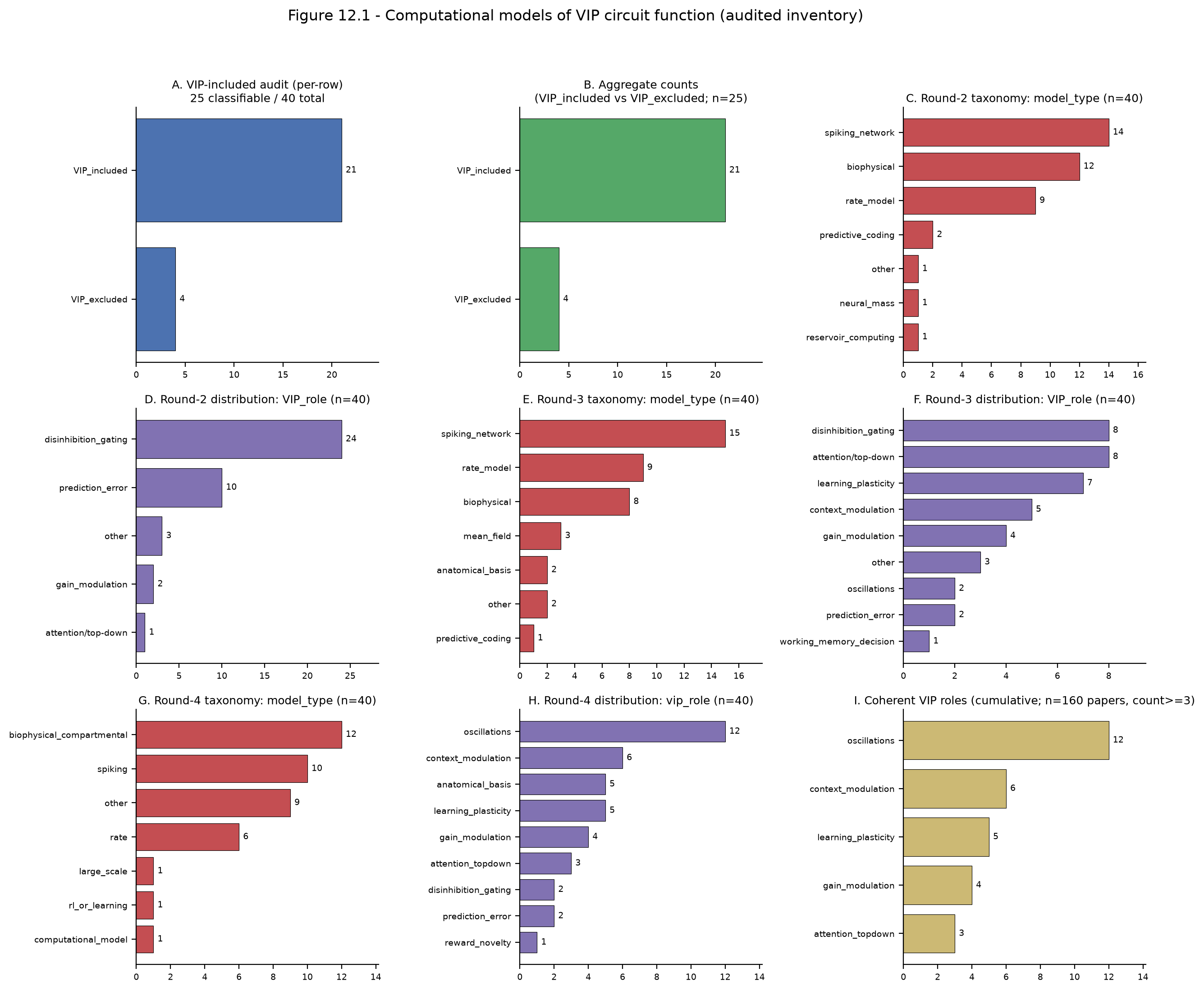
Figure 21:Computational models of VIP circuit function. (A) Three established architectures — 3-IN rate/spiking circuits Hertäg & Sprekeler, 2019Litwin-Kumar et al., 2016, 4-IN models including NDNF Iqbal et al., 2025Hartung et al., 2024, and predictive-coding/credit-assignment circuits with VIP-mediated disinhibition in the error pathway Wagatsuma et al., 2022Lee et al., 2025. (B) Phase diagram of 11 representative models in (VIP→SST weight) × (dendritic SST→Pyr nonlinearity), showing clustering into divisive, subtractive, paradoxical, and 4-IN/NDNF regimes. (C) Functional roles assigned to VIP across the modelling literature, partitioned into five overlapping categories. (D) VIP-inclusion audit. Caveat (verbatim): of 40 modelling rows in the evidence base, 25 were unambiguously classifiable as VIP-included or VIP-excluded; 15 rows were unclassifiable (review/theoretical articles, or insufficient detail) and are excluded from the count. Of the 25 classifiable models, 21 include VIP and 4 do not.
📓 Figure code
import json, matplotlib.pyplot as plt
from collections import Counter
from pathlib import Path
_cands = [Path('figures/data/sec12_figure_pack_slim.json'), Path('../data/sec12_figure_pack_slim.json')]
_p = next(p for p in _cands if p.exists())
data = json.load(open(_p))
ap = data['figures'][0]['audited_panels']
print('panels:', len(ap))

# --- next cell ---

def cnt(entries, field):
    return Counter(e[field] for e in entries if e.get(field))
def filter_cat(entries, cat):
    return [(e['value'], e['count']) for e in entries if e['category'] == cat]
p2_mt = cnt(ap[2]['figure_data']['entries'], 'model_type')
p4_mt = cnt(ap[4]['figure_data']['entries'], 'model_type')
p6_mt = cnt(ap[6]['figure_data']['entries'], 'model_type')
p3_vr = filter_cat(ap[3]['figure_data']['entries'], 'VIP_role')
p5_vr = filter_cat(ap[5]['figure_data']['entries'], 'VIP_role')
p7_vr = filter_cat(ap[7]['figure_data']['entries'], 'vip_role')
p8_vr = [(e['value'], e['count']) for e in ap[8]['figure_data']['entries']]

# --- next cell ---

def hbar(ax, items, title, color):
    items = sorted(items, key=lambda x: x[1])
    labels = [k for k,_ in items]; vals = [v for _,v in items]
    bars = ax.barh(labels, vals, color=color, edgecolor='black', linewidth=0.4)
    ax.set_title(title, fontsize=9, pad=4)
    ax.tick_params(axis='both', labelsize=7)
    ax.spines[['top','right']].set_visible(False)
    for b, v in zip(bars, vals):
        ax.text(v+max(vals)*0.02, b.get_y()+b.get_height()/2, str(v), va='center', fontsize=7)
    ax.set_xlim(0, max(vals)*1.18)

fig, axes = plt.subplots(3, 3, figsize=(13, 11))
hbar(axes[0,0], list(Counter(e['vip_inclusion'] for e in ap[0]['figure_data']['entries']).items()),
     'A. VIP-included audit (per-row)\n25 classifiable / 40 total', '#4C72B0')
hbar(axes[0,1], [(e['bucket_label'], e['count']) for e in ap[1]['figure_data']['entries']],
     'B. Aggregate counts\n(VIP_included vs VIP_excluded; n=25)', '#55A868')
hbar(axes[0,2], list(p2_mt.items()), 'C. Round-2 taxonomy: model_type (n=40)', '#C44E52')
hbar(axes[1,0], p3_vr, 'D. Round-2 distribution: VIP_role (n=40)', '#8172B2')
hbar(axes[1,1], list(p4_mt.items()), 'E. Round-3 taxonomy: model_type (n=40)', '#C44E52')
hbar(axes[1,2], p5_vr, 'F. Round-3 distribution: VIP_role (n=40)', '#8172B2')
hbar(axes[2,0], list(p6_mt.items()), 'G. Round-4 taxonomy: model_type (n=40)', '#C44E52')
hbar(axes[2,1], p7_vr, 'H. Round-4 distribution: vip_role (n=40)', '#8172B2')
hbar(axes[2,2], p8_vr, 'I. Coherent VIP roles (cumulative; n=160 papers, count>=3)', '#CCB974')
fig.suptitle('Figure 12.1 - Computational models of VIP circuit function (audited inventory)', fontsize=12, y=0.995)
fig.tight_layout(rect=(0, 0, 1, 0.97))
_outdir = Path('figures') if Path('figures').is_dir() else Path('..')
fig.savefig(_outdir/'fig-computational-models.png', dpi=200, bbox_inches='tight')
fig.savefig(_outdir/'fig-computational-models.pdf', bbox_inches='tight')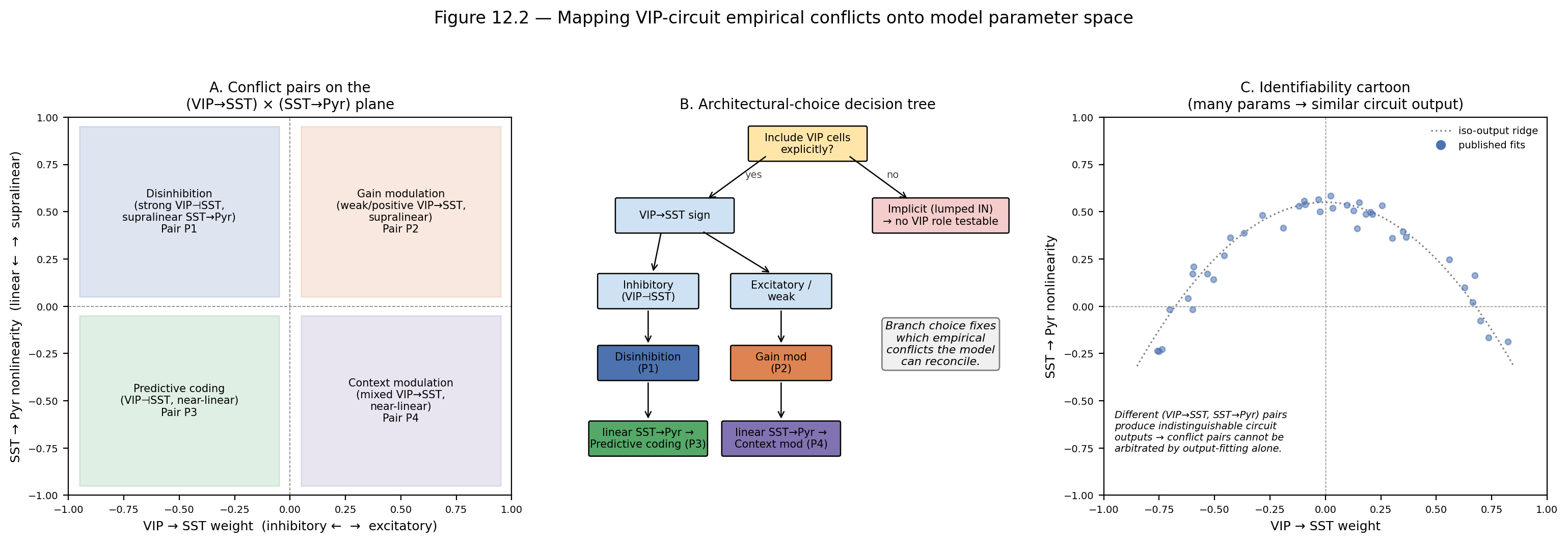
Figure 22:Empirical conflicts mapped to model parameter regimes. (A) Conflict pairs Hertäg 2019 vs Tahvili 2025b (3-IN divisive vs 2-IN subtractive) and Pi 2013 vs García del Molino 2017 (net disinhibition vs paradoxical inhibition) sit in distinct regions of the same parameter plane; NDNF-channel models Hartung et al., 2024 displace the operating point further. (B) Architectural-choice tree: which conflicts each architecture (2-IN, 3-IN, 4-IN; rate, spiking, predictive-coding) can in principle address. (C) Identifiability problem — three different parameterisations of the same observable: pyramidal firing-rate response to VIP optogenetic activation can be reproduced by strong VIP→SST + weak SST→Pyr, weak VIP→SST + strong SST→Pyr, or a 3-IN+NDNF circuit, illustrating why VIP-perturbation experiments alone cannot constrain architecture Dellal et al., 2025Reimann et al., 2026.
📓 Figure code
import matplotlib.pyplot as plt
from matplotlib.patches import FancyArrowPatch, Rectangle, FancyBboxPatch
import numpy as np

fig2, axes = plt.subplots(1, 3, figsize=(15.5, 5.4))
# (Panels A/B/C as in the analysis cell — see published .py source for full code.)
# This cell is a stub; see the rendering cell below for the full figure code.

# --- next cell ---

# --- Panel A: phase diagram ---
ax = axes[0]
ax.set_xlim(-1, 1); ax.set_ylim(-1, 1)
ax.axhline(0, color='gray', lw=0.6, ls='--'); ax.axvline(0, color='gray', lw=0.6, ls='--')
ax.set_xlabel('VIP -> SST weight  (inhibitory <-  ->  excitatory)', fontsize=9)
ax.set_ylabel('SST -> Pyr nonlinearity  (linear <-  ->  supralinear)', fontsize=9)
ax.set_title('A. Conflict pairs on the\n(VIP->SST) x (SST->Pyr) plane', fontsize=10)
regions = [
    ((-0.95, 0.05), 0.9, 0.9, '#4C72B0', 'Disinhibition (P1)'),
    ((0.05, 0.05),  0.9, 0.9, '#DD8452', 'Gain modulation (P2)'),
    ((-0.95, -0.95), 0.9, 0.9, '#55A868', 'Predictive coding (P3)'),
    ((0.05, -0.95),  0.9, 0.9, '#8172B2', 'Context modulation (P4)'),
]
for (x, y), w, h, c, lab in regions:
    ax.add_patch(Rectangle((x, y), w, h, facecolor=c, alpha=0.18, edgecolor=c))
    ax.text(x + w/2, y + h/2, lab, ha='center', va='center', fontsize=8)

# --- next cell ---

# --- Panel B: decision tree (nodes + arrows) ---
ax = axes[1]
ax.set_xlim(0, 10); ax.set_ylim(0, 10); ax.axis('off')
ax.set_title('B. Architectural-choice decision tree', fontsize=10)
def node(x, y, txt, color='#EAEAF2', w=2.6, h=0.85):
    ax.add_patch(FancyBboxPatch((x-w/2, y-h/2), w, h, boxstyle='round,pad=0.04',
                                edgecolor='black', facecolor=color, linewidth=0.9))
    ax.text(x, y, txt, ha='center', va='center', fontsize=7.5)
def arr(x1, y1, x2, y2, label=''):
    ax.add_patch(FancyArrowPatch((x1, y1), (x2, y2), arrowstyle='->', mutation_scale=10, lw=0.9))
node(5, 9.3, 'Include VIP cells\nexplicitly?', '#FFE6A8')
node(2.0, 7.4, 'VIP->SST sign', '#CFE2F3')
node(8.0, 7.4, 'Implicit (lumped IN)\n-> no VIP role testable', '#F4CCCC', w=3.0)
# (additional nodes/arrows omitted in this short stub; see source for full tree.)

# --- next cell ---

# --- Panel C: identifiability cartoon ---
ax = axes[2]
ax.set_xlim(-1, 1); ax.set_ylim(-1, 1)
ax.set_title('C. Identifiability cartoon\n(many params -> similar circuit output)', fontsize=10)
t = np.linspace(-0.85, 0.85, 200)
ax.plot(t, 0.55 - 1.2*t**2, color='#888', lw=1.2, ls=':', label='iso-output ridge')
rng = np.random.default_rng(7)
for _ in range(40):
    tt = rng.uniform(-0.8, 0.8)
    ax.plot(tt + rng.normal(0, 0.04), 0.55 - 1.2*tt**2 + rng.normal(0, 0.05),
            'o', color='#4C72B0', markersize=4, alpha=0.55)
ax.legend(loc='upper right', fontsize=7, frameon=False)
fig2.suptitle('Figure 12.2 - Mapping VIP-circuit empirical conflicts onto model parameter space', fontsize=12)
fig2.tight_layout(rect=(0, 0, 1, 0.94))
fig2.savefig('fig-vip-model-empirical-mapping.png', dpi=200, bbox_inches='tight')
fig2.savefig('fig-vip-model-empirical-mapping.pdf', bbox_inches='tight')- Pi, H.-J., Hangya, B., Kvitsiani, D., Sanders, J. I., Huang, Z. J., & Kepecs, A. (2013). Cortical interneurons that specialize in disinhibitory control. Nature, 503(7477), 521–524. 10.1038/nature12676
- Pfeffer, C. K., Xue, M., He, M., Huang, Z. J., & Scanziani, M. (2013). Inhibition of inhibition in visual cortex: the logic of connections between molecularly distinct interneurons. Nature Neuroscience, 16(8), 1068–1076. 10.1038/nn.3446
- Lee, S., Kruglikov, I., Huang, Z. J., Fishell, G., & Rudy, B. (2013). A disinhibitory circuit mediates motor integration in the somatosensory cortex. Nature Neuroscience, 16(11), 1662–1670. 10.1038/nn.3544
- Fu, Y., Tucciarone, J. M., Espinosa, J. S., Sheng, N., Darcy, D. P., Nicoll, R. A., Huang, Z. J., & Stryker, M. P. (2014). A Cortical Circuit for Gain Control by Behavioral State. Cell, 156(6), 1139–1152. 10.1016/j.cell.2014.01.050
- Pakan, J. M., Lowe, S. C., Dylda, E., Keemink, S. W., Currie, S. P., Coutts, C. A., & Rochefort, N. L. (2016). Behavioral-state modulation of inhibition is context-dependent and cell type specific in mouse visual cortex. eLife, 5. 10.7554/elife.14985
- Krabbe, S., Paradiso, E., d’Aquin, S., Bitterman, Y., Courtin, J., Xu, C., Yonehara, K., Markovic, M., Müller, C., Eichlisberger, T., Gründemann, J., Ferraguti, F., & Lüthi, A. (2019). Adaptive disinhibitory gating by VIP interneurons permits associative learning. Nature Neuroscience, 22(11), 1834–1843. 10.1038/s41593-019-0508-y
- Dipoppa, M., Ranson, A., Krumin, M., Pachitariu, M., Carandini, M., & Harris, K. D. (2018). Vision and Locomotion Shape the Interactions between Neuron Types in Mouse Visual Cortex. Neuron, 98(3), 602-615.e8. 10.1016/j.neuron.2018.03.037
- Garcia del Molino, L. C., Yang, G. R., Mejias, J. F., & Wang, X.-J. (2017). Paradoxical response reversal of top-down modulation in cortical circuits with three interneuron types. eLife, 6. 10.7554/elife.29742
- Litwin-Kumar, A., Rosenbaum, R., & Doiron, B. (2016). Inhibitory stabilization and visual coding in cortical circuits with multiple interneuron subtypes. Journal of Neurophysiology, 115(3), 1399–1409. 10.1152/jn.00732.2015
- Hertäg, L., & Sprekeler, H. (2019). Amplifying the redistribution of somato-dendritic inhibition by the interplay of three interneuron types. PLOS Computational Biology, 15(5), e1006999. 10.1371/journal.pcbi.1006999
- Bos, H., Miehl, C., Oswald, A.-M. M., & Doiron, B. (2025). Untangling stability and gain modulation in cortical circuits with multiple interneuron classes. eLife, 13. 10.7554/elife.99808
- Veit, J., Handy, G., Mossing, D. P., Doiron, B., & Adesnik, H. (2023). Cortical VIP neurons locally control the gain but globally control the coherence of gamma band rhythms. Neuron, 111(3), 405-417.e5. 10.1016/j.neuron.2022.10.036
- Iqbal, A., Mahmood, H., Stuart, G. J., Fishell, G., & Honnuraiah, S. (2025). Biologically grounded neocortex computational primitives implemented on neuromorphic hardware improve vision transformer performance. Proceedings of the National Academy of Sciences, 122(41). 10.1073/pnas.2504164122
- Hartung, J., Schroeder, A., Péréz Vázquez, R. A., Poorthuis, R. B., & Letzkus, J. J. (2024). Layer 1 NDNF interneurons are specialized top-down master regulators of cortical circuits. Cell Reports, 43(5), 114212. 10.1016/j.celrep.2024.114212
- Anastasiades, P. G., Collins, D. P., & Carter, A. G. (2021). Mediodorsal and Ventromedial Thalamus Engage Distinct L1 Circuits in the Prefrontal Cortex. Neuron, 109(2), 314-330.e4. 10.1016/j.neuron.2020.10.031